AR for Product Marketing: A Guide for Enterprise Teams
When augmented reality earns its place in a launch, which format to pick, what it takes to build, and how to know it worked
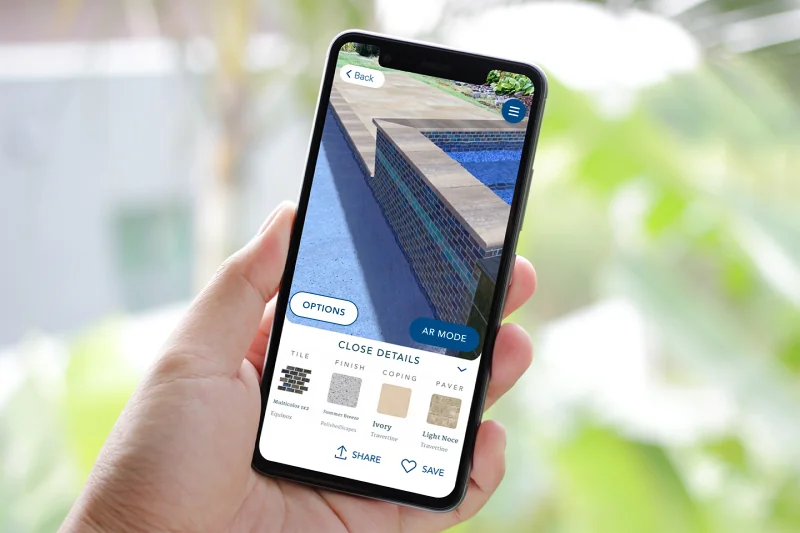
Augmented reality is good at one thing above all: putting a product where the buyer is. In their backyard, on their desk, next to the gear they already own, at actual scale.
When that matters to the purchase, AR can carry more of the sales story than a video, a deck or a PDF. When it doesn’t, AR is an expensive way to make a phone heavy.
This guide is for marketing leaders evaluating AR for a launch, a sales tool or an event. It covers when AR helps, when it doesn’t, which format fits, what it takes to build, and how to measure it. Every example is something Fair Worlds has built.
When AR helps (and when it doesn’t)
We’ve been building XR for marketing and sales teams for nine years. The pattern is consistent: AR works when the buyer needs to see something they can’t easily picture.
AR earns its place when buyers need to:
- See the product in their own space. Pools, outdoor kitchens, equipment, anything where “will it fit, and will it look right?” is the real question.
- See it at actual scale. A spec sheet says 10 feet. AR shows 10 feet.
- Customize it and compare options. Change the tile, the finish, the countertop, then see the result where it will live.
- Look closely at detail, or watch it work. Textures, finishes, internals, moving parts.
- Share it with someone else in the decision. A saved design or a short video travels to a spouse, a boss or a buying committee.
AR is not great at conveying a lot of complex information that has no one-to-one visual. Holding up a phone like a camera gets uncomfortable within a few minutes, which isn’t enough time to deliver an e-book’s worth of content.
We say this from experience. When Dell asked us for an AR experience that would be “something interactive, like an e-book on steroids” for Cybersecurity Awareness Month, we recommended against AR and pitched a narrative audio series instead. Here’s why we made that call, and what we made.
If you want a structured gut-check, our AR fit framework walks through the questions we ask first: How will AR help customers consider buying? Do you have channels to bring customers to the experience? And is this the first step of a longer immersive roadmap, or a one-off?
Pick the format: where will buyers meet it?
The most common question we get is “which platform should we build for?” The answer depends on where your buyer meets the product, and how many times they’ll come back.
Web AR: no app, no download
The buyer scans a QR code or taps a link and AR opens in the mobile browser. No app store, no install.
This is the right default for campaigns, events, print and anywhere you get one shot at attention. For the DCAC 2022 AR scavenger hunt, we knew we couldn’t ask conference attendees to download an app, so we built the game for the browser. For Luckie and Regions Bank, web AR turned 10-foot-tall physical installations across multiple states into an interactive moment people could record and share, on a short timeframe.
Web AR also works for a quiet, high-stakes audience. For AMD’s EPYC 7003 launch, we built 12 password-protected pages that showed the new chip in interactive 3D and AR, no app needed, for a select group of reviewers ahead of launch.
Native mobile app: for repeat use and depth
A native iOS and Android app is the right call when people will come back to it, when the interactions are rich, or when it’s a tool rather than a moment.
NPT Backyard is the clearest example. Homeowners and contractors customize a pool from a large library of photoreal tiles and finishes, place it in their own backyard in AR, then save and share the design. It’s available on iOS and Android, and it’s the kind of app a buyer opens more than once.
Social AR: reach over depth
Face filters and world effects on social platforms trade depth for reach. They’re good for fan engagement and top-of-funnel buzz, less good for a considered B2B purchase.
Our Count Crowley face filter turned fans into the comic’s title character, and it landed during Halloween. Social AR can also extend a bigger build: the Bull BBQ Customizer paired a web-based 3D customizer with an Instagram AR filter so shoppers could see the grill in their own backyard. Social platforms change their rules for brand effects often, so confirm what’s currently supported before you plan a campaign around one.
Headsets: Meta Quest and Apple Vision Pro
Mixed reality headsets put a full-scale product in the room with the buyer, hands-free. Fewer people own them, so they make the most sense where you control the device: showrooms, trade show booths, briefing centers.
We built our own Pool Designer for Meta Quest 3 and 3S because their mixed reality passthrough lets a buyer see a pool in their actual environment and design it in real time. Pool builders can use it in showrooms, and it can be white-labeled with any brand. For spatial computing on Apple’s side, our work with Nomad Go included UI design aligned with Apple Vision Pro principles alongside AR markers for their iPad app.
Location-based AR: when the place is the product
Sometimes what you’re marketing is a place, a story or an event. Space-Time Adventure Tours, our own location-based AR walking tour of Seattle Center as it was during the 1962 World’s Fair, uses GPS and AR to guide visitors through a 20-to-30-minute route. Accessibility is a core part of the project.
Make one asset do several jobs
The strongest AR programs don’t stop at one format. They reuse the same 3D assets across channels.
NPT is a good example. The NPT Backyard app came first. Then interactive print ads in trade magazines used the ad image to trigger a 3D pool from the app in web AR, with a new pool each month to keep the campaign fresh, plus printed postcards that triggered the same experience at trade shows. User testing on the app surfaced the first thing pool buyers asked, “What will the water look like?”, which led to the NPT Water Color web app.
The same thinking applies to launch content. For AMD, the 3D assets that powered the AR pages also produced a 3D animated video for the same reviewers.
Plan your 3D assets once, and every later channel gets cheaper.
What it takes to build
3D assets
Every AR experience starts with a real-time 3D model of the product. If your engineering or product team has CAD files, those are usually the starting point. AMD supplied 3D assets from its engineering team; for Optimum Pools, we worked from CAD models to produce 36 optimized model variants. If there’s no CAD, models can be built from spec drawings, photography or scanning.
CAD files aren’t AR-ready out of the box. They need to be optimized so they load fast and look right on a phone, which is a planned phase of every project, not an afterthought. Social AR platforms in particular have tight file-size limits.
Team and process
A typical build runs through discovery (what success looks like, which format, which products), asset preparation, development, and launch with analytics connected. Our 3D product configurator guide walks through the same phases in more detail, since many AR projects sit on top of a configurator.
Timelines and budget
Scope drives both. A single product in web AR is a much smaller project than a native app with a large catalog, and adding headset versions or integrations with your e-commerce or CRM systems adds more. The fastest way to a realistic number is to start with one product and one channel, prove it works, then expand. Book a call and we’ll scope it with you.
How to measure it
Decide what success looks like before the build starts, and wire the tracking in at launch. Useful measures:
- Engagement: sessions, time in the experience, and how far people get.
- Intent: saved designs, shares, configurations completed.
- Pipeline: qualified leads, quote requests, meetings booked.
- Lift: performance of the page or campaign the AR sits inside, compared with the same page without it.
- Event goals: at trade shows, the behavior you’re trying to drive. The DCAC scavenger hunt made some keys available only at specific places and times, to reward the most determined players and steer attendees to specific conference events.
Pick two or three that tie to a business goal. A big session count with no downstream action is a novelty, not a sales tool.
Frequently asked questions
Is AR worth it for B2B product marketing?
Yes, when the product is physical, configurable or hard to picture, and when the buyer has to convince other people. AR gives the buying committee something concrete to look at and share. For abstract or information-heavy offerings, another format (video, audio, interactive 3D on the web) is often the better choice.
Do our customers have to download an app?
No. Web AR runs in the mobile browser from a QR code or link. Native apps make sense for tools people return to, like a design app or a sales tool.
Do we need 3D models before we start?
No. CAD files are a great starting point, but models can also be built from drawings, photos or scans. Either way, the models need to be optimized for real-time use on a phone or headset.
What’s the difference between AR and a 3D product configurator?
A configurator lets a buyer change the product: colors, materials, components. AR places that product in the buyer’s real space. They work well together, which is why many of our projects, like NPT Backyard and the Bull BBQ Customizer, do both.
Should we build for Apple Vision Pro or Meta Quest?
Build for a headset when you control the device and the setting: a showroom, a trade show booth, a briefing center. For broad reach, start with web AR or a mobile app, then add a headset version that reuses the same 3D assets.
Talk to us
If you have a launch, a sales tool or an event ahead and want to know whether AR belongs in the mix, let’s talk. We’ll tell you honestly if it doesn’t.
See more of our work on our augmented reality and AR, VR and 3D app development pages.