Why We're Hard to Describe (And Why That's Our Strength)
Yes, we're hard to describe. In an industry that moves this fast, in a technology landscape that shifts this dramatically, being hard to define might be the most honest thing we can be. We're the company that finds the right tool for the job. We're the team that creates wonder while solving real problems. We're the partners who adapt when the landscape shifts.
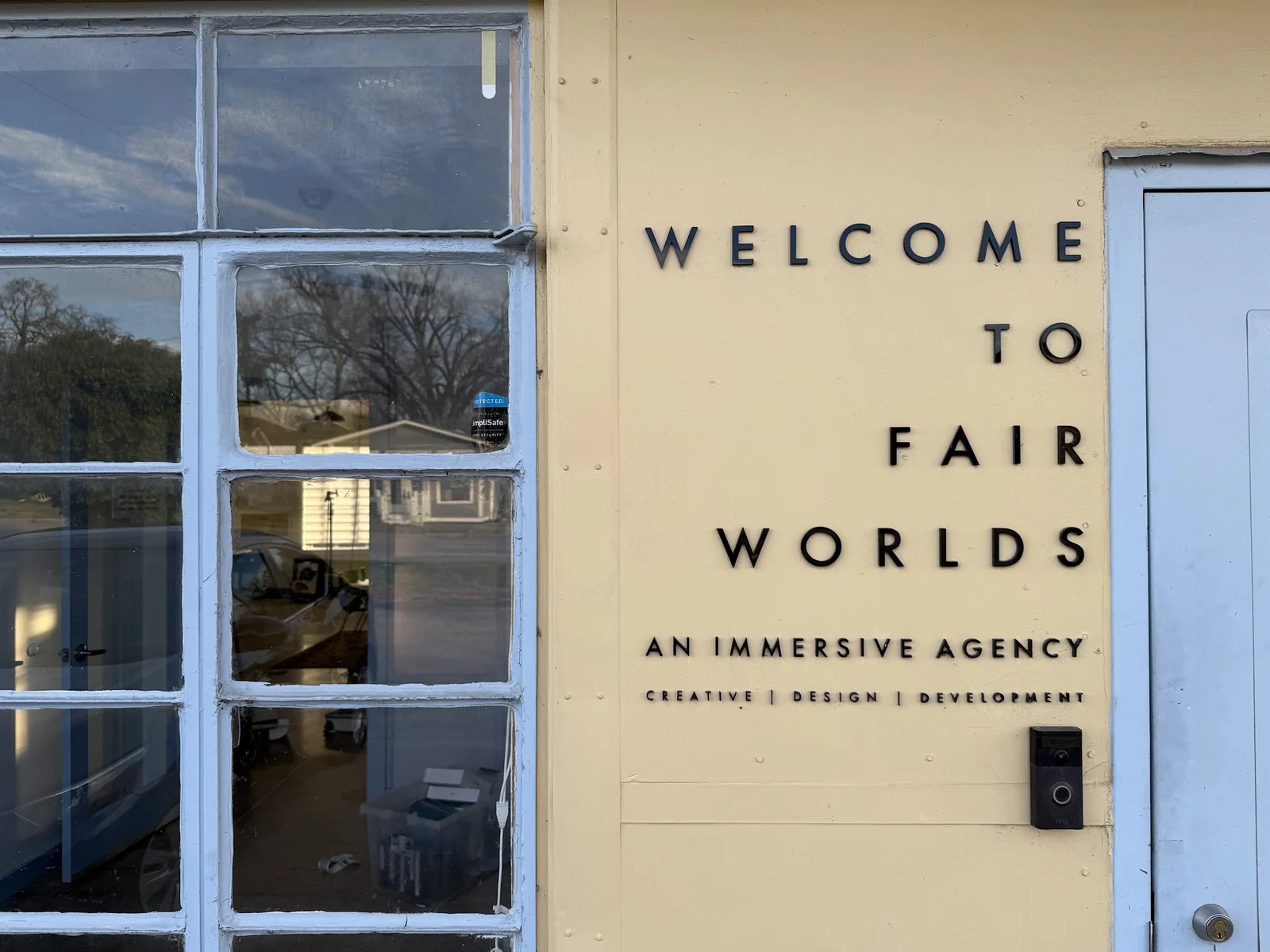
Describing Fair Worlds has always been difficult. And after nine years, we’ve stopped apologizing for it.
Fair Worlds began as a ‘VR company’—back when the Oculus DK2 was the hottest thing in tech and the future of virtual reality seemed blindingly bright. Before Fair Worlds, I’d been working on 360 videos and VR projects at my previous agency, and then at the company I co-founded with my wife after our daughter was born (Hunt, Gather, now called Civilization). The amount of money and excitement around VR in those early days was at levels I’d never seen before. (Until now, of course with AI which makes that seem quaint)
But here’s the thing: if we’d stayed “a VR company,” I’d probably be writing a very different kind of blog post today. Instead, we’re still here, still making work we’re incredibly proud of, and still finding new ways to create wonder and to solve big problems for our clients.
So what are we, if not just a VR company?
Adaptability Isn’t a Buzzword—It’s Survival
Our first big pivot happened the same time as everyone else’s…during COVID. The world shut down right after we finished a VR project for Baker Hughes in Florence, Italy (February 2020). VR at events—our bread and butter, the work we’d been doing at Super Bowls, Mobile World Congress, and Dell Technologies World—evaporated overnight.
We had to pivot, fast.
We got insanely lucky and created long-term partnerships with the largest grocery store in Texas (H-E-B) and the largest pool company (which is publicly traded) POOLCORP. Two industries that did insanely well during COVID. Two teams that were digital-first. And to be perfectly honest, those partnerships made a really awful couple of years a delight to work through.
But it wasn’t just luck. It was also our willingness to look at what technology could actually solve for these clients, rather than forcing a VR headset into every solution.
For HEB, we created an enterprise-grade virtual retail product that took the problem of shelf refreshes from month-long cycles to days. For POOLCORP, we solved the problem of visualizing a pool in your backyard. We used 3D design and game engines to create enterprise ready tools.
During that same time, when all we could do was go on a walk, we challenged ourselves to create an internal project around the idea of ‘what is an immersive walk?’ That led to years of research and development culminating in a project we’re insanely proud of called Space-Time Adventure Tours. We’re hoping it gains more traction this year, because it represents something core to our belief system: that we can bring a new magical layer to important historical places in the real world, or even just your backyard.
We’ve ridden other ups and downs. The home VR market cooled. People weren’t as excited to put on headsets at events (though that seems to be coming back). We’ve seen multiple closures of VR development shops just in recent months.
But we’re still here. Because we learned early that the medium isn’t the mission.
The Medium Follows the Mission
Three years ago, Dell came to us with a project. They were and are one of our main clients—we’d done virtual reality projects and countless videos for them before—and they thought this new project should be augmented reality.
We looked at what they were actually trying to accomplish. And we took a Hail Mary based on belief and personal passion. We told them the actual medium they should be using was immersive audio and storytelling. A format that’s been popularized since the early 1900s: the old-timey radio drama.
Flash forward: we’ve been creating The Dell Cybersecurity Tapes for over three years. It’s some of the best work the company has ever done. We’ve built partnerships with NVIDIA and AMD as sponsors. We’re developing gated content, interactive training materials, and expanding the podcast’s reach in ways we never imagined.
And the main piece of technology? An MP3 file.
This is what I mean when I say we’re hard to describe. We’re not dogmatic about technology. We’re dogmatic about the outcome.
Sometimes the right technology is VR. Sometimes it’s AR. Sometimes it’s a podcast. Sometimes it’s computer vision analyzing grocery store shelves. We’ve learned to lead with the problem and the desired experience, then find the technology that best serves it.
Accessibility as a Competitive Advantage
Since 2020, we’ve been working with accessibility advocate Andy Slater. He’s also our sound designer. He also happens to be blind.
This is something I think separates us quite a bit from other firms: we really think accessibility first.
The power of audio as an immersive tool cannot be overstated. Case in point: our podcast that Andy produces with Brad Parrett. We’ve proven that you don’t need a headset to transport someone to another place, to make them feel something, to create an immersive experience.
When we design AR experiences, we’re thinking about how someone who can’t see the visual layer can still participate. When we create VR experiences, we’re thinking about audio design with the same rigor as visual design—because for many users, that’s the primary experience.
It’s made our work better. It’s expanded our thinking. And it’s created experiences that serve more people more effectively.
Technology in Service of Wonder
AI is moving faster than I ever thought VR could move. The AI development made what I thought was the super-fast development of VR look like a snail’s pace.
We’ve been integrating AI into our workflows and projects. Some of which we can’t talk about yet - but it’s incredibly exciting.
But here’s what hasn’t changed: our north star isn’t the technology itself. It’s what the technology enables.
Fair Worlds, beyond being an immersive company, a VR company, an AR company—we’re really excellent at looking at the technology landscape and adapting to it. Finding new ways to bring wonder to people. Creating value for our clients in ways that have never been possible before.
This technology both solves problems in ways you can’t imagine and transports you to places you never thought possible.
That’s the through-line in our work. From enterprise-grade retail visualization to AR tours of Central Park to cybersecurity podcasts to VR fundraising experiences—it’s all in service of creating wonder and solving real problems.
What’s Next
I’m very proud of the work and team we’ve built at Fair Worlds. I can’t wait to show you what we’ve been working on for the last 12 months and the projects to come in the coming year.
We’re expanding our AI integration. We’re developing new spatial computing experiences. We’re creating more audio storytelling. We’re solving logistics problems with computer vision. We’re building AR experiences that bring historical moments to life.
And yes, we’re still hard to describe.
But maybe that’s exactly the point. In an industry that moves this fast, in a technology landscape that shifts this dramatically, being hard to define might be the most honest thing we can be.
We’re the company that finds the right tool for the job. We’re the team that creates wonder while solving real problems. We’re the partners who adapt when the landscape shifts.
And nine years in, that feels like exactly who we should be.